Jan 5, 2026
Jan 5, 2026
Jan 5, 2026
Is It Possible to Track Brand Mentions in AI Search?
Is It Possible to Track Brand Mentions in AI Search?
Is It Possible to Track Brand Mentions in AI Search?

Siddhant Paliwal
CTO, Bear
In This Article
Share on
Is It Possible to Track Brand Mentions in AI Search?
TL;DR: Yes, it is absolutely possible—and increasingly critical—to track brand mentions in AI search engines like ChatGPT, Google AI Overviews, and Perplexity. As consumer behavior shifts towards AI-powered search, traditional SEO metrics are becoming obsolete. Visibility in these new answer engines is the new currency. Specialized platforms like Bear AI are essential for monitoring brand visibility, tracking citations, and understanding your footprint in this new landscape. Early adopters of Answer Engine Optimization (AEO) are already seeing significant advantages, and the time to act is now.
The Seismic Shift in Search: From Blue Links to AI Conversations
The internet's front door is changing. For two decades, businesses have competed for visibility on Google's search engine results page (SERP). Now, a new paradigm is emerging. According to a recent McKinsey study, half of all consumers are now intentionally using AI-powered search, a trend that is projected to funnel a staggering $750 billion in US revenue by 2028. This isn't just a fleeting trend; it's a fundamental reshaping of how users find information and discover brands.
For Heads of SEO, VPs of Sales, and marketing leaders, this raises an urgent question: if your customers are asking AI assistants about your industry, is your brand part of the conversation? The alarming reality is that most businesses have no idea. Traditional brand strength and high rankings on Google do not guarantee visibility in AI-generated answers. This new ecosystem requires a new approach, new tools, and a new way of thinking about brand presence.
Why Your Old SEO Dashboard Can't Help You Here
The metrics that have guided digital marketing for years—keyword rankings, click-through rates, and organic traffic—are losing their relevance in the age of AI search. Answer engines operate on a different principle. Instead of presenting a list of links, they synthesize information from multiple sources to provide a single, comprehensive answer. In this world, a **citation** or a **brand mention** is the new click.
This shift is causing widespread anxiety among businesses. A survey highlighted by Search Engine Land found that nearly 90% of businesses are worried about losing their online findability in the AI era. The same study revealed a crucial insight: 75.5% of businesses now prioritize brand visibility within AI-generated answers, even if it doesn't come with a direct link. They understand that being part of the AI's answer is a powerful endorsement, shaping consumer perception long before a purchase decision is made.
Not All AI Engines Are Created Equal: A Multi-Platform Reality
One of the biggest mistakes a brand can make is assuming all AI search engines behave the same way. Research from BrightEdge reveals stark differences in how platforms like ChatGPT, Google AI Overviews, and Perplexity mention brands:
ChatGPT is a brand maximizer, mentioning brands in a remarkable 99.3% of its eCommerce responses and averaging 5.84 brands per answer. It heavily favors established retail giants and marketplace domains.
Google AI Overviews is a brand minimalist, including brands in just 6.2% of its responses. It prioritizes educational content and heavily relies on sources like YouTube.
Perplexity strikes a balance, mentioning brands in 85.7% of its answers while also providing the highest number of citations (an average of 8.79 per response), making it a champion of transparency.
These are not random variations; they are fundamental design choices. A strategy that works for ChatGPT will likely fail on Google AI Overviews. Winning in this new landscape requires a nuanced, multi-platform approach and, most importantly, the ability to track your performance across each of these distinct ecosystems.
The Core Challenge: Why Manual Tracking Is a Losing Battle
If you can't measure it, you can't improve it. The primary challenge in this new era is the lack of a unified, reliable system for tracking brand presence in AI search. Attempting to do this manually is not just inefficient; it's practically impossible. The sheer volume of prompts, the constant evolution of the models, and the distinct behaviors of each platform create a complex and dynamic environment. Without a dedicated tool, you are flying blind, unable to answer critical questions:
How often is our brand mentioned compared to our competitors?
What is the context of these mentions? Are they positive, negative, or neutral?
Which of our content assets are being used as sources by AI engines?
Are there technical issues on our site preventing AI crawlers from accessing our content?
Which specific AI-driven interactions are generating leads and revenue?
Introducing Bear AI: Your Eyes and Ears in the Age of AI Search
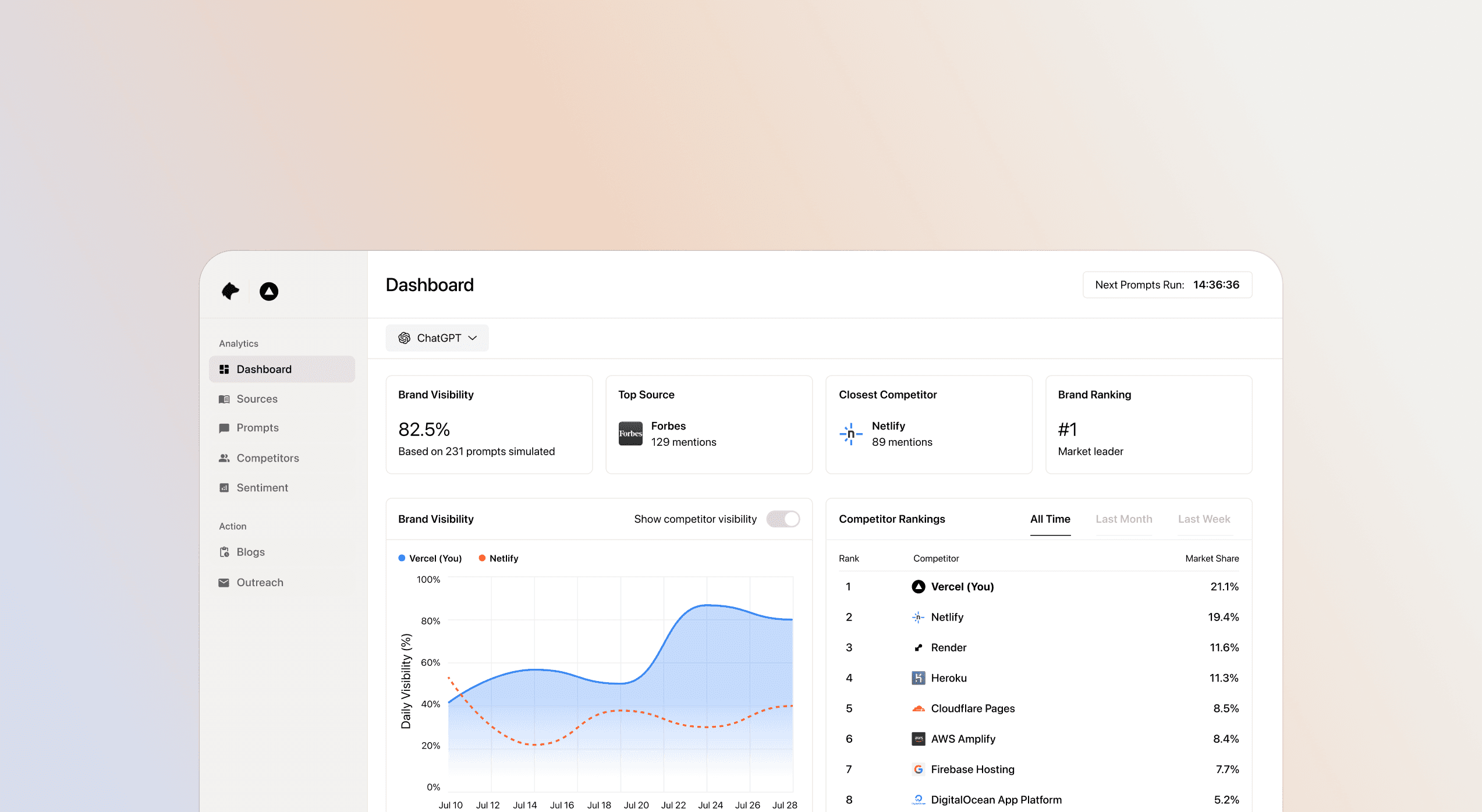
While the challenge is significant, the solution is here. Bear AI is a comprehensive platform designed specifically to help businesses navigate and dominate the world of Answer Engine Optimization (AEO). While other tools like Semrush or BrightEdge offer partial solutions, Bear AI provides an end-to-end system for tracking, analysis, and optimization.
Here’s how Bear AI empowers you to conquer AI search:
1. Deep Source Analytics
Bear AI goes beyond simple mention counting. Its **Deep Source Analytics** tells you exactly what’s working and what’s not. It identifies the precise content—from your blog, Reddit, YouTube, or Wikipedia—that AI engines are citing. This allows you to double down on effective content strategies and understand the true sources of your AI visibility.
2. Real-Time Lead Tracking and ROI
For a VP of Sales, this is the game-changer. Bear AI provides **lead tracking** that shows you the exact pages being picked up by AI search and, crucially, who is clicking through to your site. This creates a clear line of sight from AI visibility to real revenue, allowing you to measure ROI and build powerful retargeting campaigns.
3. Comprehensive Site Audits
You can have the best content in the world, but if AI crawlers like GPTBot and PerplexityBot can't access it, you're invisible. Bear AI’s **site audit** tool is specifically designed to catch the technical errors that hinder AI agents, ensuring your entire site is accessible and optimized for citation.
4. The Blog Agent: AI-Optimized Content Creation
Knowing what works is half the battle; creating content that wins is the other. Bear AI’s **Blog Agent** creates AEO-optimized content based on proven strategies. It automatically incorporates JSON-LD, strong schema, internal linking, and other advanced optimization tactics to ensure your content is primed for AI visibility.
5. Competitive Intelligence and Outreach
Bear AI helps you understand your competitive landscape and take action. It can even find the emails of authors who own the share of voice for key prompts, enabling targeted **email outreach** to build relationships and earn valuable citations.
The First-Mover Advantage: Why Early Adopters Are Winning
The transition to AI search is happening now, and a significant competitive advantage is available to those who act decisively. Multiple industry reports have shown that early AEO adopters are capturing 3.4 times more traffic from answer engines than their slower competitors. This isn't just about incremental gains; it's about securing a foundational presence in what will soon be the primary channel for digital discovery.
By using a platform like Bear AI to track your brand mentions and optimize your content, you are not just keeping pace with change—you are getting ahead of it. You are building a defensible moat around your brand's visibility in an ecosystem where your competitors are likely still struggling to find their footing.
Frequently Asked Questions (FAQs)
1. Can I track my brand mentions in AI search manually?
While you can manually enter prompts into different AI engines, it is not a scalable or effective strategy. The results are often personalized and can change rapidly. A dedicated platform like Bear AI is necessary for consistent, comprehensive, and actionable tracking.
2. Which AI search engine is the most important to track?
All of them. As the data shows, each engine has a different user base and a different way of presenting information. A comprehensive AEO strategy requires tracking your visibility across ChatGPT, Google AI Overviews, Perplexity, and other emerging platforms.
3. How long does it take to see results from AEO efforts?
While some technical fixes can yield immediate improvements in crawlability, building authority and earning citations is a long-term strategy. Most experts suggest a 3-6 month timeframe to see meaningful changes in AI search visibility, but platforms like Bear AI can accelerate this process by providing clear, data-driven guidance.
4. What is the difference between a brand mention and a citation?
A brand mention is any instance where your brand name appears in an AI-generated answer. A citation is a specific link back to a source page on your website. While citations are valuable for driving traffic, brand mentions are crucial for building awareness and authority, even without a link.
5. How does Bear AI compare to competitors like Gumshoe AI or Profound AI?
While several tools are emerging in the AEO space, Bear AI differentiates itself with a holistic, action-oriented platform. It combines deep source analytics, real-time lead tracking with ROI visibility, a content-generating Blog Agent, and technical site audits—providing a complete solution from analysis to execution.
6. What is the ROI on tracking AI search visibility?
The ROI comes from multiple sources: increased lead generation from AI-driven traffic, enhanced brand authority and trust, and the long-term competitive advantage of securing a strong foothold in the next generation of search. With tools like Bear AI, you can directly track leads and revenue generated from your AEO efforts.
7. Should I optimize my content differently for each AI engine?
Yes, to an extent. For example, video content is highly effective for Google AI Overviews, while comprehensive, authoritative guides perform well on Perplexity. A robust AEO platform will help you understand these nuances and tailor your content strategy accordingly, while still maintaining a core, unified message.
Conclusion: The Future Is Here, and It's Trackable
The question is no longer *if* AI will change search, but *how* you will adapt to this change. Tracking brand mentions in AI search is not just possible; it is an essential business practice for any company that wants to remain relevant in the digital landscape. The days of relying on traditional SEO are over. The future belongs to the brands that can master the art and science of Answer Engine Optimization.
Don't let your brand become invisible. Take control of your AI search presence and turn this paradigm shift into your greatest competitive advantage. Get started at this link and see what the future of search holds for you.
Is It Possible to Track Brand Mentions in AI Search?
TL;DR: Yes, it is absolutely possible—and increasingly critical—to track brand mentions in AI search engines like ChatGPT, Google AI Overviews, and Perplexity. As consumer behavior shifts towards AI-powered search, traditional SEO metrics are becoming obsolete. Visibility in these new answer engines is the new currency. Specialized platforms like Bear AI are essential for monitoring brand visibility, tracking citations, and understanding your footprint in this new landscape. Early adopters of Answer Engine Optimization (AEO) are already seeing significant advantages, and the time to act is now.
The Seismic Shift in Search: From Blue Links to AI Conversations
The internet's front door is changing. For two decades, businesses have competed for visibility on Google's search engine results page (SERP). Now, a new paradigm is emerging. According to a recent McKinsey study, half of all consumers are now intentionally using AI-powered search, a trend that is projected to funnel a staggering $750 billion in US revenue by 2028. This isn't just a fleeting trend; it's a fundamental reshaping of how users find information and discover brands.
For Heads of SEO, VPs of Sales, and marketing leaders, this raises an urgent question: if your customers are asking AI assistants about your industry, is your brand part of the conversation? The alarming reality is that most businesses have no idea. Traditional brand strength and high rankings on Google do not guarantee visibility in AI-generated answers. This new ecosystem requires a new approach, new tools, and a new way of thinking about brand presence.
Why Your Old SEO Dashboard Can't Help You Here
The metrics that have guided digital marketing for years—keyword rankings, click-through rates, and organic traffic—are losing their relevance in the age of AI search. Answer engines operate on a different principle. Instead of presenting a list of links, they synthesize information from multiple sources to provide a single, comprehensive answer. In this world, a **citation** or a **brand mention** is the new click.
This shift is causing widespread anxiety among businesses. A survey highlighted by Search Engine Land found that nearly 90% of businesses are worried about losing their online findability in the AI era. The same study revealed a crucial insight: 75.5% of businesses now prioritize brand visibility within AI-generated answers, even if it doesn't come with a direct link. They understand that being part of the AI's answer is a powerful endorsement, shaping consumer perception long before a purchase decision is made.
Not All AI Engines Are Created Equal: A Multi-Platform Reality
One of the biggest mistakes a brand can make is assuming all AI search engines behave the same way. Research from BrightEdge reveals stark differences in how platforms like ChatGPT, Google AI Overviews, and Perplexity mention brands:
ChatGPT is a brand maximizer, mentioning brands in a remarkable 99.3% of its eCommerce responses and averaging 5.84 brands per answer. It heavily favors established retail giants and marketplace domains.
Google AI Overviews is a brand minimalist, including brands in just 6.2% of its responses. It prioritizes educational content and heavily relies on sources like YouTube.
Perplexity strikes a balance, mentioning brands in 85.7% of its answers while also providing the highest number of citations (an average of 8.79 per response), making it a champion of transparency.
These are not random variations; they are fundamental design choices. A strategy that works for ChatGPT will likely fail on Google AI Overviews. Winning in this new landscape requires a nuanced, multi-platform approach and, most importantly, the ability to track your performance across each of these distinct ecosystems.
The Core Challenge: Why Manual Tracking Is a Losing Battle
If you can't measure it, you can't improve it. The primary challenge in this new era is the lack of a unified, reliable system for tracking brand presence in AI search. Attempting to do this manually is not just inefficient; it's practically impossible. The sheer volume of prompts, the constant evolution of the models, and the distinct behaviors of each platform create a complex and dynamic environment. Without a dedicated tool, you are flying blind, unable to answer critical questions:
How often is our brand mentioned compared to our competitors?
What is the context of these mentions? Are they positive, negative, or neutral?
Which of our content assets are being used as sources by AI engines?
Are there technical issues on our site preventing AI crawlers from accessing our content?
Which specific AI-driven interactions are generating leads and revenue?
Introducing Bear AI: Your Eyes and Ears in the Age of AI Search
While the challenge is significant, the solution is here. Bear AI is a comprehensive platform designed specifically to help businesses navigate and dominate the world of Answer Engine Optimization (AEO). While other tools like Semrush or BrightEdge offer partial solutions, Bear AI provides an end-to-end system for tracking, analysis, and optimization.
Here’s how Bear AI empowers you to conquer AI search:
1. Deep Source Analytics
Bear AI goes beyond simple mention counting. Its **Deep Source Analytics** tells you exactly what’s working and what’s not. It identifies the precise content—from your blog, Reddit, YouTube, or Wikipedia—that AI engines are citing. This allows you to double down on effective content strategies and understand the true sources of your AI visibility.
2. Real-Time Lead Tracking and ROI
For a VP of Sales, this is the game-changer. Bear AI provides **lead tracking** that shows you the exact pages being picked up by AI search and, crucially, who is clicking through to your site. This creates a clear line of sight from AI visibility to real revenue, allowing you to measure ROI and build powerful retargeting campaigns.
3. Comprehensive Site Audits
You can have the best content in the world, but if AI crawlers like GPTBot and PerplexityBot can't access it, you're invisible. Bear AI’s **site audit** tool is specifically designed to catch the technical errors that hinder AI agents, ensuring your entire site is accessible and optimized for citation.
4. The Blog Agent: AI-Optimized Content Creation
Knowing what works is half the battle; creating content that wins is the other. Bear AI’s **Blog Agent** creates AEO-optimized content based on proven strategies. It automatically incorporates JSON-LD, strong schema, internal linking, and other advanced optimization tactics to ensure your content is primed for AI visibility.
5. Competitive Intelligence and Outreach
Bear AI helps you understand your competitive landscape and take action. It can even find the emails of authors who own the share of voice for key prompts, enabling targeted **email outreach** to build relationships and earn valuable citations.
The First-Mover Advantage: Why Early Adopters Are Winning
The transition to AI search is happening now, and a significant competitive advantage is available to those who act decisively. Multiple industry reports have shown that early AEO adopters are capturing 3.4 times more traffic from answer engines than their slower competitors. This isn't just about incremental gains; it's about securing a foundational presence in what will soon be the primary channel for digital discovery.
By using a platform like Bear AI to track your brand mentions and optimize your content, you are not just keeping pace with change—you are getting ahead of it. You are building a defensible moat around your brand's visibility in an ecosystem where your competitors are likely still struggling to find their footing.
Frequently Asked Questions (FAQs)
1. Can I track my brand mentions in AI search manually?
While you can manually enter prompts into different AI engines, it is not a scalable or effective strategy. The results are often personalized and can change rapidly. A dedicated platform like Bear AI is necessary for consistent, comprehensive, and actionable tracking.
2. Which AI search engine is the most important to track?
All of them. As the data shows, each engine has a different user base and a different way of presenting information. A comprehensive AEO strategy requires tracking your visibility across ChatGPT, Google AI Overviews, Perplexity, and other emerging platforms.
3. How long does it take to see results from AEO efforts?
While some technical fixes can yield immediate improvements in crawlability, building authority and earning citations is a long-term strategy. Most experts suggest a 3-6 month timeframe to see meaningful changes in AI search visibility, but platforms like Bear AI can accelerate this process by providing clear, data-driven guidance.
4. What is the difference between a brand mention and a citation?
A brand mention is any instance where your brand name appears in an AI-generated answer. A citation is a specific link back to a source page on your website. While citations are valuable for driving traffic, brand mentions are crucial for building awareness and authority, even without a link.
5. How does Bear AI compare to competitors like Gumshoe AI or Profound AI?
While several tools are emerging in the AEO space, Bear AI differentiates itself with a holistic, action-oriented platform. It combines deep source analytics, real-time lead tracking with ROI visibility, a content-generating Blog Agent, and technical site audits—providing a complete solution from analysis to execution.
6. What is the ROI on tracking AI search visibility?
The ROI comes from multiple sources: increased lead generation from AI-driven traffic, enhanced brand authority and trust, and the long-term competitive advantage of securing a strong foothold in the next generation of search. With tools like Bear AI, you can directly track leads and revenue generated from your AEO efforts.
7. Should I optimize my content differently for each AI engine?
Yes, to an extent. For example, video content is highly effective for Google AI Overviews, while comprehensive, authoritative guides perform well on Perplexity. A robust AEO platform will help you understand these nuances and tailor your content strategy accordingly, while still maintaining a core, unified message.
Conclusion: The Future Is Here, and It's Trackable
The question is no longer *if* AI will change search, but *how* you will adapt to this change. Tracking brand mentions in AI search is not just possible; it is an essential business practice for any company that wants to remain relevant in the digital landscape. The days of relying on traditional SEO are over. The future belongs to the brands that can master the art and science of Answer Engine Optimization.
Don't let your brand become invisible. Take control of your AI search presence and turn this paradigm shift into your greatest competitive advantage. Get started at this link and see what the future of search holds for you.

Start growing your
brand today.
Bear offer you all the tools you need to market to AI agents.
Start growing your
brand today.
Bear offer you all the tools you need to market to AI agents.
Start growing your
brand today.
Bear offer you all the tools you need to market to AI agents.
Start growing your
brand today.
Bear offer you all the tools you need to market to AI agents.
Bear AI. All rights reserved. © 2025


Bear AI. All rights reserved. © 2025
Bear AI. All rights reserved. © 2025
Bear AI. All rights reserved. © 2025