Nov 24, 2025
Nov 24, 2025
Nov 24, 2025
How AEO Differs from Traditional SEO
How AEO Differs from Traditional SEO
How AEO Differs from Traditional SEO

Siddhant Paliwal
CTO, Bear
In This Article
Traditional SEO: The Foundation of Discoverability
What Exactly Is AEO?
Why AEO Matters
Traditional SEO vs. AEO at a Glance
How to Integrate AEO into Your SEO Strategy
Conclusion
SEO vs. AEO FAQ
Share on
The way people search for information is shifting, fast. Where once we relied on a list of blue links, search in 2026 is now increasingly filtered through AI assistants and conversational interfaces. Instead of “Googling” a question, more users are asking ChatGPT, Gemini, or Perplexity, and getting direct, summarized answers in return.
This is where AEO (Answer Engine Optimization) comes in. It’s not replacing SEO, but it is redefining what visibility means in an AI-first world. Below, we’ll break down how AEO differs from traditional SEO, why it matters, and how marketers can start preparing for the next era of search.
Traditional SEO: The Foundation of Discoverability
For two decades, SEO (Search Engine Optimization) has been the cornerstone of online visibility. The playbook is familiar:
Research high-intent keywords.
Optimize on-page structure and metadata.
Build backlinks and authority.
Ensure fast load times and mobile performance.
The goal? Rank higher on search engines like Google or Bing to drive organic traffic and conversions. Success is measured through metrics like rankings, impressions, clicks, and engagement, signals that your content is attracting attention and users are finding it useful.
SEO remains essential. But the way people find and consume information is evolving, and that’s where AEO takes the stage.
What Exactly Is AEO?
Answer Engine Optimization (AEO) is about preparing your content for a world where AI systems, not just search engines, are the intermediaries between your brand and your audience.
When someone asks ChatGPT, “How long does bottled soda stay fizzy?”, they’re not scanning a results page. They’re getting an immediate, synthesized answer, often built from multiple web sources. The goal of AEO is to make your content the one these systems trust and cite.
AEO applies the same logic as SEO, making information discoverable, but for a different kind of “reader”: AI models. These models depend on clarity, structure, and factual accuracy to interpret data. That’s why AEO emphasizes:
Structured data and schema markup
Entity-based optimization (people, places, concepts)
Natural, conversational phrasing that reflects how users ask questions
Short, verifiable statements instead of fluffy marketing language
Why AEO Matters
AI-driven search isn’t just a new interface, it’s a new ecosystem. Platforms like Google’s AI Overviews, ChatGPT, and Perplexity are becoming default gateways to information. They’re changing what “visibility” looks like.
In this environment, even the best-ranked content can become invisible if it isn’t machine-readable or contextually clear. AEO ensures your brand’s knowledge and expertise are surfaced, summarized, or cited when AI systems respond to user queries.
Think of it as expanding your SEO strategy to visibility on another channel with similar mechanics. Brands that integrate both will maintain visibility across more platforms, and capture market share faster.
Traditional SEO vs. AEO at a Glance
Category | Traditional SEO | AEO (Answer Engine Optimization) |
|---|---|---|
Primary Goal | Rank higher in search engine results pages (SERPs) to drive organic traffic | Be cited or sourced in AI-generated and voice answers |
Audience | Human web searchers | AI systems, chatbots, and voice assistants |
Keywords | Short and long-tail search phrases | Natural language questions and conversational phrasing |
Output | Webpage click and on-site visit | Direct spoken or summarized answer |
Core Technique | Keyword optimization, backlinking, on-page SEO | Structured, factual, and semantically clear content |
Formatting Focus | Titles, headers, meta descriptions, alt text | Schema markup, entities, and machine-readable context |
Content Types | Blog posts, product pages, landing pages | FAQ sections, knowledge hubs, concise factual answers |
Devices / Interfaces | Desktop and mobile browsers | Voice assistants and AI interfaces |
KPIs & Metrics | Rankings, organic traffic, CTR, bounce rate, conversions | Mentions or citations in AI outputs, visibility in AI Overviews |
Primary Channels | Google, Bing, Yahoo | ChatGPT, Gemini, Perplexity, Claude, Google AI Overviews |
User Journey | Search > Click > Visit website | Question > AI answer > Source mention or summary |
How to Integrate AEO into Your SEO Strategy
Adopt structured data markup
Use schema to label key entities (products, reviews, FAQs, stats) so AI crawlers can easily parse and connect your content.Answer questions directly
Write in natural, conversational language that mirrors how people ask questions to AI or voice assistants.Prioritize factual clarity
Keep statements short, verifiable, and specific. Avoid vague copy that doesn’t teach or inform.Monitor AI citations
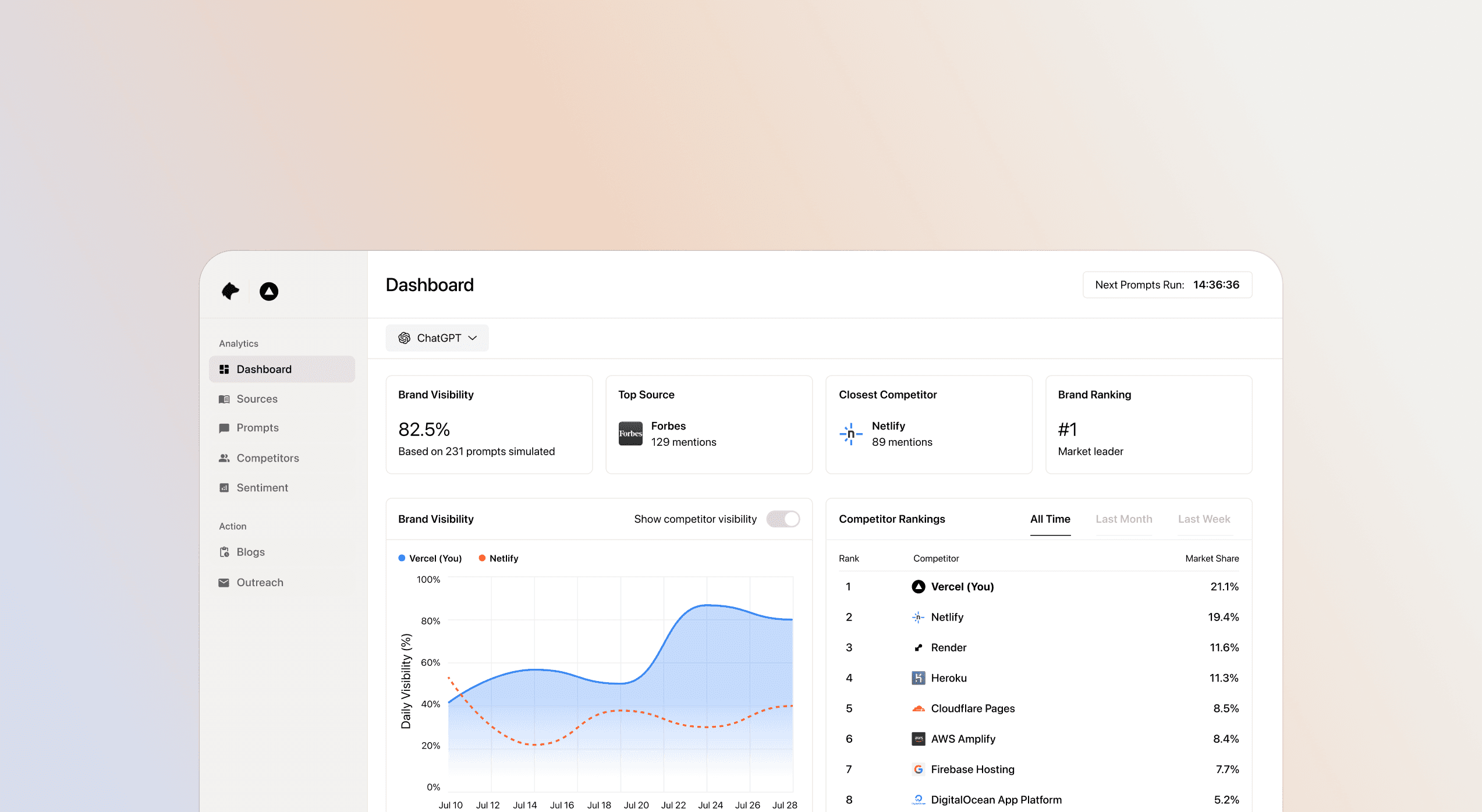
Tools like Bear AI can help you see whether your brand is being cited, an emerging visibility metric.Keep SEO fundamentals strong
AEO doesn’t replace traditional SEO hygiene. Site speed, mobile responsiveness, and backlinks still build authority and trust signals that AI systems use to rank and reference content.
Conclusion
AEO isn’t the death of SEO, it’s its evolution. Traditional SEO ensures your content is visible to searchers. AEO ensures it’s understood by the AI systems shaping the future of search.
As the digital landscape becomes increasingly conversational and AI-driven, marketers who master both disciplines will dominate visibility, not just on Google SERPs, but within the ever increasing volume of AI searches that users make every day.
SEO vs. AEO FAQ
1. Will AEO replace SEO?
Not yet. AEO builds on SEO. SEO makes your content discoverable by humans, while AEO makes it interpretable by machines. Both are essential for full-funnel visibility.
2. Should I use them both?
Absolutely. Use SEO to grow organic reach and authority, and AEO to ensure your insights are cited or surfaced in AI-driven environments like ChatGPT or Google’s AI Overviews.
3. What defines good AEO content?
Structured data, precise factual writing, schema markup, and conversational phrasing aligned with how users naturally ask questions.
4. What defines strong SEO content?
Keyword-rich, authoritative pages backed by backlinks, optimized metadata, and solid technical performance that drives search rankings.
The way people search for information is shifting, fast. Where once we relied on a list of blue links, search in 2026 is now increasingly filtered through AI assistants and conversational interfaces. Instead of “Googling” a question, more users are asking ChatGPT, Gemini, or Perplexity, and getting direct, summarized answers in return.
This is where AEO (Answer Engine Optimization) comes in. It’s not replacing SEO, but it is redefining what visibility means in an AI-first world. Below, we’ll break down how AEO differs from traditional SEO, why it matters, and how marketers can start preparing for the next era of search.
Traditional SEO: The Foundation of Discoverability
For two decades, SEO (Search Engine Optimization) has been the cornerstone of online visibility. The playbook is familiar:
Research high-intent keywords.
Optimize on-page structure and metadata.
Build backlinks and authority.
Ensure fast load times and mobile performance.
The goal? Rank higher on search engines like Google or Bing to drive organic traffic and conversions. Success is measured through metrics like rankings, impressions, clicks, and engagement, signals that your content is attracting attention and users are finding it useful.
SEO remains essential. But the way people find and consume information is evolving, and that’s where AEO takes the stage.
What Exactly Is AEO?
Answer Engine Optimization (AEO) is about preparing your content for a world where AI systems, not just search engines, are the intermediaries between your brand and your audience.
When someone asks ChatGPT, “How long does bottled soda stay fizzy?”, they’re not scanning a results page. They’re getting an immediate, synthesized answer, often built from multiple web sources. The goal of AEO is to make your content the one these systems trust and cite.
AEO applies the same logic as SEO, making information discoverable, but for a different kind of “reader”: AI models. These models depend on clarity, structure, and factual accuracy to interpret data. That’s why AEO emphasizes:
Structured data and schema markup
Entity-based optimization (people, places, concepts)
Natural, conversational phrasing that reflects how users ask questions
Short, verifiable statements instead of fluffy marketing language
Why AEO Matters
AI-driven search isn’t just a new interface, it’s a new ecosystem. Platforms like Google’s AI Overviews, ChatGPT, and Perplexity are becoming default gateways to information. They’re changing what “visibility” looks like.
In this environment, even the best-ranked content can become invisible if it isn’t machine-readable or contextually clear. AEO ensures your brand’s knowledge and expertise are surfaced, summarized, or cited when AI systems respond to user queries.
Think of it as expanding your SEO strategy to visibility on another channel with similar mechanics. Brands that integrate both will maintain visibility across more platforms, and capture market share faster.
Traditional SEO vs. AEO at a Glance
Category | Traditional SEO | AEO (Answer Engine Optimization) |
|---|---|---|
Primary Goal | Rank higher in search engine results pages (SERPs) to drive organic traffic | Be cited or sourced in AI-generated and voice answers |
Audience | Human web searchers | AI systems, chatbots, and voice assistants |
Keywords | Short and long-tail search phrases | Natural language questions and conversational phrasing |
Output | Webpage click and on-site visit | Direct spoken or summarized answer |
Core Technique | Keyword optimization, backlinking, on-page SEO | Structured, factual, and semantically clear content |
Formatting Focus | Titles, headers, meta descriptions, alt text | Schema markup, entities, and machine-readable context |
Content Types | Blog posts, product pages, landing pages | FAQ sections, knowledge hubs, concise factual answers |
Devices / Interfaces | Desktop and mobile browsers | Voice assistants and AI interfaces |
KPIs & Metrics | Rankings, organic traffic, CTR, bounce rate, conversions | Mentions or citations in AI outputs, visibility in AI Overviews |
Primary Channels | Google, Bing, Yahoo | ChatGPT, Gemini, Perplexity, Claude, Google AI Overviews |
User Journey | Search > Click > Visit website | Question > AI answer > Source mention or summary |
How to Integrate AEO into Your SEO Strategy
Adopt structured data markup
Use schema to label key entities (products, reviews, FAQs, stats) so AI crawlers can easily parse and connect your content.Answer questions directly
Write in natural, conversational language that mirrors how people ask questions to AI or voice assistants.Prioritize factual clarity
Keep statements short, verifiable, and specific. Avoid vague copy that doesn’t teach or inform.Monitor AI citations
Tools like Bear AI can help you see whether your brand is being cited, an emerging visibility metric.Keep SEO fundamentals strong
AEO doesn’t replace traditional SEO hygiene. Site speed, mobile responsiveness, and backlinks still build authority and trust signals that AI systems use to rank and reference content.
Conclusion
AEO isn’t the death of SEO, it’s its evolution. Traditional SEO ensures your content is visible to searchers. AEO ensures it’s understood by the AI systems shaping the future of search.
As the digital landscape becomes increasingly conversational and AI-driven, marketers who master both disciplines will dominate visibility, not just on Google SERPs, but within the ever increasing volume of AI searches that users make every day.
SEO vs. AEO FAQ
1. Will AEO replace SEO?
Not yet. AEO builds on SEO. SEO makes your content discoverable by humans, while AEO makes it interpretable by machines. Both are essential for full-funnel visibility.
2. Should I use them both?
Absolutely. Use SEO to grow organic reach and authority, and AEO to ensure your insights are cited or surfaced in AI-driven environments like ChatGPT or Google’s AI Overviews.
3. What defines good AEO content?
Structured data, precise factual writing, schema markup, and conversational phrasing aligned with how users naturally ask questions.
4. What defines strong SEO content?
Keyword-rich, authoritative pages backed by backlinks, optimized metadata, and solid technical performance that drives search rankings.

Start growing your
brand today.
Bear offer you all the tools you need to market to AI agents.
Start growing your
brand today.
Bear offer you all the tools you need to market to AI agents.
Start growing your
brand today.
Bear offer you all the tools you need to market to AI agents.
Start growing your
brand today.
Bear offer you all the tools you need to market to AI agents.
Bear AI. All rights reserved. © 2025


Bear AI. All rights reserved. © 2025
Bear AI. All rights reserved. © 2025
Bear AI. All rights reserved. © 2025